








Orval Abbey
a unique place between history, spirituality and heritage

Discover one of Belgium's most famous abbeys
Nestled in the heart of a wooded valley in the Gaume region, just a few kilometres from the French border, the’Orval Abbey is one of Belgium's most iconic historical sites.
Known around the world for its famous Trappist beer, Orval Abbey is above all a place steeped in history, spirituality, and heritage. Founded in the Middle Ages, destroyed and then rebuilt over the centuries, it now attracts thousands of visitors eager to discover its majestic ruins, its museum, its gardens, and its unique atmosphere.
Situated close to Lorraine, Meuse, Montmédy, and the Fort de Fermont, Orval Abbey is an unmissable visit for lovers of history, culture, and heritage tourism.
An abbey founded in the 12th century
The history of Orval Abbey begins in the Middle Ages.
The site initially hosted a religious community from the 11th century before officially becoming a Cistercian abbey in 1132. Quickly, Orval established itself as one of the most important monastic centres in the region.
For several centuries, the monks developed:
- agriculture ;
- livestock farming ;
- logging ;
- craftsmanship ;
- The welcome of travellers.
The abbey then entered a period of prosperity that greatly contributed to the development of the surrounding area.

The Legend of the Val d'Or
The origin of the name «Orval» is linked to a famous medieval legend.
According to tradition, Countess Matilda of Tuscany is said to have lost her wedding ring in a spring located on the abbey's grounds. After praying, a trout is said to have surfaced, miraculously returning the lost ring.
Astonished, Mathilde would then have spoken the words:
« This is truly a golden valley. »
This legend remains today one of Orval's most famous symbols and explains the presence of the celebrated trout holding a ring in the abbey's emblem.
An abbey marked by destruction
Like many great European monuments, Orval Abbey has weathered several difficult periods throughout its history.
Over the centuries, it underwent:
- fires ;
- looting ;
- destruction arising from military conflicts; ;
- The consequences of European wars.
The most dramatic episode occurs during the French Revolution. In 1793, the buildings were set on fire and the monks were forced to abandon the abbey for good. The ruins remained abandoned for over a century.
The rebirth of Orval Abbey
At the start of the 20th century, a vast reconstruction project was launched to bring the site back to life.
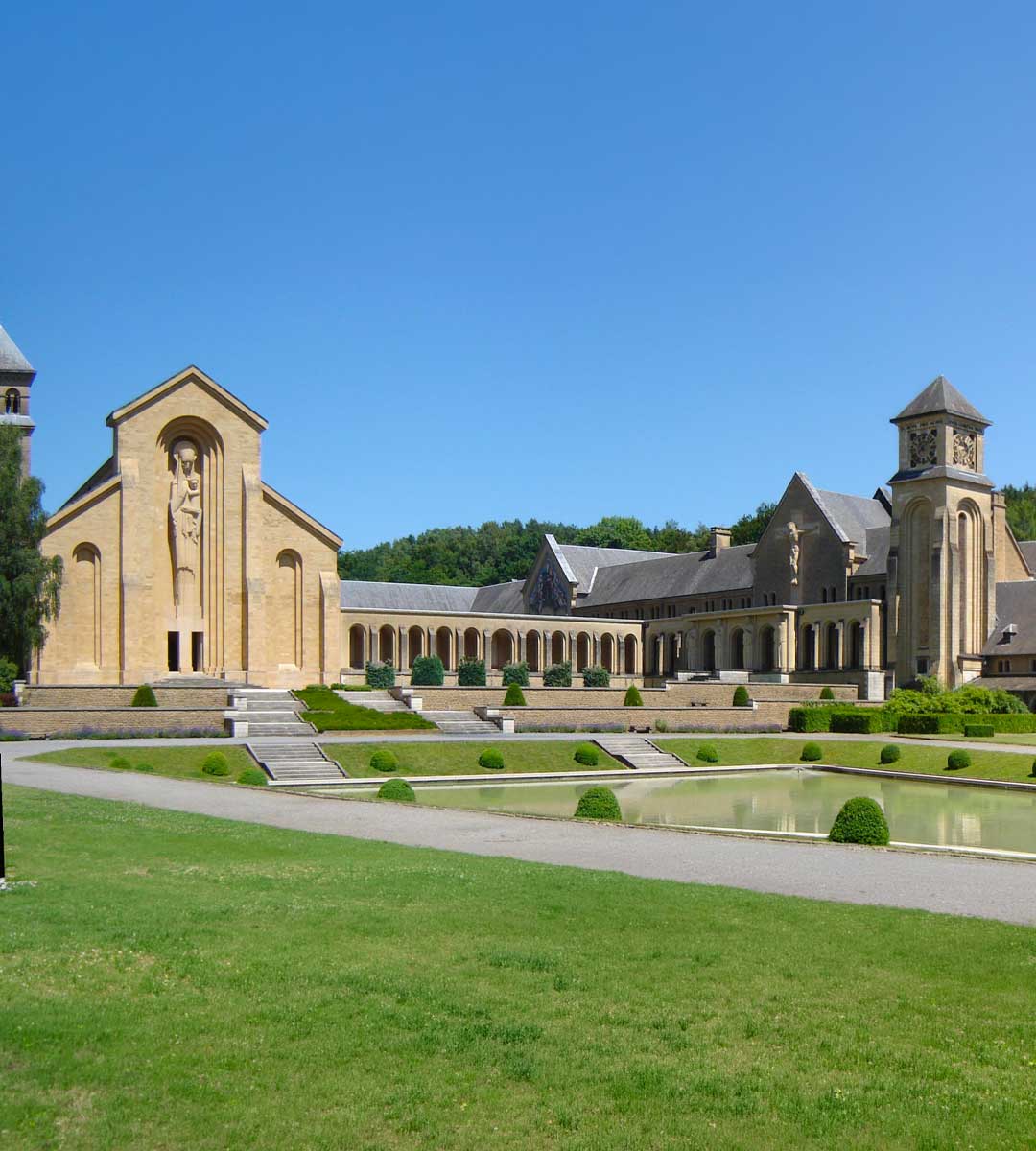
Work begins upon the return of a community of Trappist monks. A new abbey is gradually built near the medieval ruins.
The monastic community is still present today and continues the Cistercian tradition in an exceptional setting.
This renaissance makes Orval one of the finest examples of heritage and religious restoration in Europe.
The ruins of the old abbey
One of the most impressive elements of the visit is undoubtedly the discovery of the ruins of the old medieval abbey.
The route allows you to explore:
- the remains of the abbey church ;
- the cloister ;
- the monastic halls ;
- The historic cellars ;
- the old convent buildings.
The ensemble offers a particularly striking atmosphere where history still seems present in every stone.
These ruins today form one of the most beautiful monastic complexes that can be visited in Belgium.
The Abbey of Orval Museum
The visit also includes several museum spaces dedicated to the history of the site and monastic life.
Visitors discover:
- the history of the abbey; ;
- the different construction periods ;
- the techniques used by the monks ;
- Cistercian traditions ;
- The archaeological objects found on the site.
Audiovisual animations and models help to better understand the abbey's evolution through the centuries.
The famous Orval Trappist beer
Orval Abbey is world-renowned for its Trappist beer.
Produced at the abbey brewery since the early 20th century, Orval beer is now considered one of the benchmarks of Belgian brewing tradition.
Its unique recipe and specific manufacturing process give it a character particularly appreciated by beer lovers around the world.
The site also offers:
- a space dedicated to brewing know-how; ;
- the discovery of the history of production; ;
- a specialist shop ;
- the abbey's famous products.
A place of enduring spirituality
Unlike many historical sites that have become solely tourist attractions, Orval Abbey remains an active monastery today.
A community of Trappist monks continues to live there according to the Cistercian rule.
This monastic presence contributes strongly to the special atmosphere of the place, where heritage, silence, and spirituality meet.
Visitors can attend religious services and discover a living facet of European monastic tradition.
A must-see visit near Lorraine
Located in immediate proximity to the French border, Orval Abbey is an ideal excursion from:
- The Meuse ;
- Verdun ;
- Montmédy ;
- Longwy; ;
- Fort Fermont ;
- Luxembourg.
Its historical and heritage wealth makes it one of the most visited sites in the entire region.
Why visit Orval Abbey?
Visiting Orval Abbey allows:
- to discover one of Belgium's most famous abbeys; ;
- to explore exceptional medieval ruins; ;
- to understand the history of the Cistercian monks; ;
- to discover the famous Orval Trappist beer; ;
- to visit a unique historical site; ;
- to take advantage of a remarkable natural setting; ;
- to experience a blend of heritage, culture, and spirituality.
Frequently asked questions
The Abbey of Orval is located where?
Orval Abbey is located in Villers-devant-Orval, in the province of Luxembourg in Belgium, near the French border.
L'Abbaye d'Orval est célèbre pour plusieurs raisons : * **Sa bière :** C'est l'une des bières trappistes les plus connues et appréciées au monde. La bière d'Orval, avec son goût unique et complexe, est brassée selon des méthodes traditionnelles au sein de l'abbaye. * **Son fromage :** Le fromage d'Orval est également réputé pour sa saveur distinctive. Il est produit par les moines de l'abbaye et sa fabrication est intimement liée à l'histoire monastique. * **Son histoire et son architecture :** L'abbaye a une longue histoire remontant au XIIe siècle. Bien qu'elle ait été détruite et reconstruite à plusieurs reprises, ses ruines actuelles et l'abbaye moderne témoignent de son passé riche et de son architecture impressionnante. * **Son lieu de retraite spirituelle :** En tant qu'abbaye trappiste, Orval est un lieu de prière, de travail et de vie communautaire pour les moines, attirant les personnes en quête de spiritualité et de quiétude. * **Ses sources et légendes :** La légende de la "Fontaine Miraculeuse" (la source qui aurait donné son nom à l'abbaye, "l'or vallée") contribue à son aura mystique et à son attrait touristique.
It is known for its historic ruins, its community of Trappist monks, and its famous Orval beer.
Can the abbey ruins be visited?
Yes, the medieval ruins are part of the tour open to the public.
Do monks still live at Orval?
Yes, the abbey still hosts a community of Trappist monks.
Can one discover the making of Orval beer?
The site offers sections dedicated to the history and brewing expertise related to the famous Trappist beer.
The link between Orval and the Fort de Fermont is that they are both important historical sites in the Meuse region of France, with Orval being an abbey and the Fort de Fermont being a military fortification. They are both accessible to tourists and offer a glimpse into the region's rich history and heritage.
The two sites are among the major historical locations situated near the Franco-Belgian border and offer complementary visits to discover the region's history and heritage.